
• Careers
  • About
  • Contact Us
  • Care Estimates
  • Pay My Bill
  • Give Now
  • MyChart Login
  • Schedule Appointment
Riverside Health

Riverside Health

  • Medical Services
    • Cancer Care
    • Diagnostic Imaging
    • Gastroenterology
    • Heart and Vascular
    • Lifelong Health
    • Mental Health
    • Neurological and Spine Institute
    • Orthopedics
    • Primary Care
    • Urgent Care
    • Women's Health
    • View All Services
  • Conditions & Treatments
  • Locations
  • Find a Doctor
  • Patients & Visitors
    • Accepted Insurance
    • Care Estimates
    • Conflict Resolution
    • Patient Rights
    • Paying for Healthcare Services
    • Recognize a Caregiver
    • Send a Web Wish
    • Volunteer
  • Health Resources
    • Clinical Trials
    • Events
    • Healthy You Blogs
    • Healthy You Podcast
    • Riverside Simulation Training Lab
    • Symptom Checker
  • Careers
  • About
  • Contact Us
  • Care Estimate
  • Pay My Bill
  • Give Now
  • MyChart Login
  • Schedule Appointment
  • News Center
Need Help?

For help in finding a physician, making appointments and general information call Riverside Nurse.

1-800-675-6368
Follow Us Today
  • Twitter
  • Facebook
  • LinkedIn
  • Instagram
  • YouTube
Orthopedics
  • OrthoConnect
    • Walk-In Clinic
  • Total Joint Replacement
    • Total Hip Replacement Surgery
    • Total Knee Replacement Surgery
    • Post-operative Information
    • Joint Replacement Frequently Asked Questions
  • Sports Medicine
    • What Hurts
    • Common Sport Injuries
    • Tricare Patients
    • Your Sports Medicine Team
    • Community and Athletic Partnerships
  • Trauma and Fracture Care
  • Shoulder and Elbow Treatment
  • Foot and Ankle Treatment
  • Hand and Wrist Treatment
  • Your Orthopedic Team
  • Patient Stories
    • Debbie’s Story
    • Iva's Story
    • Jean's Story
    • Jill's Story
    • Leah's Story
    • Robert's Story
    • Danielle's Story
  • Education Resource Library
    • Conditions and Treatments
  • Home
  • Medical Services
  • Orthopedics
  • Education Resource Library
  • Conditions and Treatments
  • Osgood-Schlatter Disease
  • Icon Label
    • Icon Label
    • Twitter
    • Icon Label
  • Icon Label

Osgood-Schlatter Disease

  • Key Points
  • Overview
  • Causes
  • Symptoms
  • Diagnosis
  • Treatment
  • Prevention
  • Next Steps
Key Points

  • Osgood-Schlatter disease is a common cause of knee pain in growing children and teens.
  • It most often affects young athletes involved in running, jumping or pivoting sports.
  • The condition occurs when repeated stress irritates the growth plate at the top of the shinbone.
  • Symptoms include pain, swelling and tenderness just below the kneecap.
  • Most cases improve with rest, activity modification and physical therapy.

Overview

What Is Osgood-Schlatter Disease?
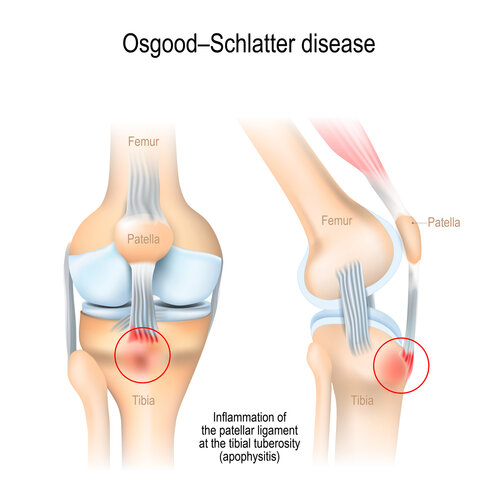
Osgood-Schlatter disease. inflammation of the patellar ligament at the tibial tuberosity. Anatomy of human knee (femur, patella, patellar ligament, tibia and fibula). vector illustration. leg bones and joint. Side and front (anterior) view of the knee

Osgood-Schlatter disease is an overuse injury that affects the growth plate at the front of the knee, where the patellar tendon attaches to the shinbone (tibia). Growth plates are areas of developing tissue near the ends of long bones in children and adolescents.

During growth spurts, bones, muscles and tendons grow quickly. Repetitive stress from sports can pull on this area, leading to pain and swelling just below the kneecap. Over time, a small bony bump may form at the top of the shin.

Osgood-Schlatter disease is one of the most common causes of knee pain in active teens, especially those between ages 10 and 15. The condition is temporary and usually resolves once growth is complete.


Back to top

Causes

What Causes Osgood-Schlatter Disease?

Osgood-Schlatter disease develops from repetitive strain on the knee during periods of rapid growth.

Common contributing factors include:

  • Frequent running and jumping
  • Sports such as basketball, soccer, volleyball, gymnastics or track
  • Tight quadriceps or hamstring muscles
  • Rapid growth during adolescence
  • Overtraining without adequate rest

When the thigh muscles repeatedly pull on the patellar tendon, it places stress on the growth plate. Because this area is softer and still developing, it is more vulnerable to irritation.
Young athletes who train year-round or play on multiple teams may have a higher risk of developing symptoms.

Back to top

Symptoms

Signs and Symptoms of Osgood-Schlatter Disease

Symptoms often develop gradually and may worsen with activity.

Common symptoms include:

  • Pain just below the kneecap
  • Swelling or tenderness over the shinbone
  • A visible or firm bump at the top of the shin
  • Knee pain that increases with running, jumping or kneeling
  • Tightness in the front of the thigh

The pain may affect one or both knees. Symptoms typically improve with rest but can return when activity resumes.

If knee pain continues for more than a few days or interferes with sports participation, medical evaluation is recommended.


Back to top

Diagnosis

How Is Osgood-Schlatter Disease Diagnosed?

A sports medicine provider will begin with a detailed history and physical exam.

Diagnostic steps may include:

  • Discussing sports participation and training schedule
  • Examining the knee for tenderness, swelling and range of motion
  • Checking muscle flexibility and strength
  • Ordering X-rays if needed to rule out other causes of knee pain

In most cases, Osgood-Schlatter disease is diagnosed based on symptoms and physical findings. Imaging may show changes at the growth plate but is not always required.

Early diagnosis helps guide safe activity modification and prevents worsening symptoms.


Back to top

Treatment

How Is Osgood-Schlatter Disease Treated?

Treatment focuses on relieving pain, reducing inflammation and allowing the growth plate to calm down. Surgery is rarely needed.

Non-Surgical Treatment

Most cases improve with conservative care, including:

  • Rest from high-impact activities
  • Activity modification is generally sufficient without the need to completely stop all sports activities
  • Ice after activity to reduce swelling
  • Over-the-counter anti-inflammatory medication for discomfort
  • Physical therapy to stretch and strengthen the quadriceps and hamstrings
  • Use of a patellar tendon strap to reduce strain

The goal is to manage symptoms while allowing continued participation in sports at a tolerable level. Most teens return to full activity once growth slows and symptoms improve.

Surgical Treatment

Surgery is uncommon and usually reserved for persistent symptoms after growth is complete. In rare cases, removal of painful bone fragments may be considered.

Back to top

Prevention

Can Osgood-Schlatter Disease Be Prevented?

Osgood-Schlatter disease cannot always be prevented, especially during rapid growth. However, certain steps can lower the risk of flare-ups.

Prevention strategies include:

  • Avoiding overtraining or year-round single-sport play
  • Incorporating rest days into practice schedules
  • Stretching regularly to maintain flexibility
  • Strengthening leg muscles to support the knee
  • Addressing knee pain early instead of playing through it

Parents and coaches should take complaints of persistent knee pain in teens seriously. Early evaluation can prevent worsening symptoms and help young athletes stay active safely.


Back to top
Next Steps

Osgood-Schlatter disease can be frustrating for active kids and teens, but it is usually temporary and manageable with the right care plan.

If your child is experiencing ongoing knee pain, swelling below the kneecap or difficulty participating in sports, our sports medicine and orthopedic team is here to help. We provide comprehensive evaluation, personalized treatment plans and guidance to support a safe return to play while protecting long-term knee health.

If you’re wondering where the best place is to get care, please see our guide below:

If your problem is life- or limb-threatening, call 911 or go to the emergency room.

Sports Medicine Hotline – Call 757-534-6767, 7am-10pm, 7 days a week to schedule an appointment with a sports medicine specialist. Same day/next day availability in most cases.

OrthoConnect Orthopedic Urgent Care – Walk-in clinic at our Newport News location only on Tues-Thurs. 7am-2pm or schedule an appointment through MyChart for the location and time that is convenient for you.

Orthopedic Specialists - Schedule through MyChart or call 757-534-9988.
(804-693-0529 for Gloucester, 757-302-2700 for the Eastern Shore)

Back to top

Riverside Health

Our mission to care for others as we would care for those we love drives us to support a number of health, education and community programs.

  • Twitter
  • Facebook
  • LinkedIn
  • Instagram
  • YouTube
  • News Center
  • Nursing Recruitment & Resources
  • Price Transparency
  • Provider Recruitment & Engagement
  • Riverside Foundation

Need Help?

For help in finding a physician, making appointments and general information call Riverside Nurse.

1-800-675-6368
  • Privacy Policy
  • Non-Discrimination Policy
  • Web Privacy Policy
©2025 - Riverside Health | All right reserved
Schedule Appointment Symptom Checker Contact Us